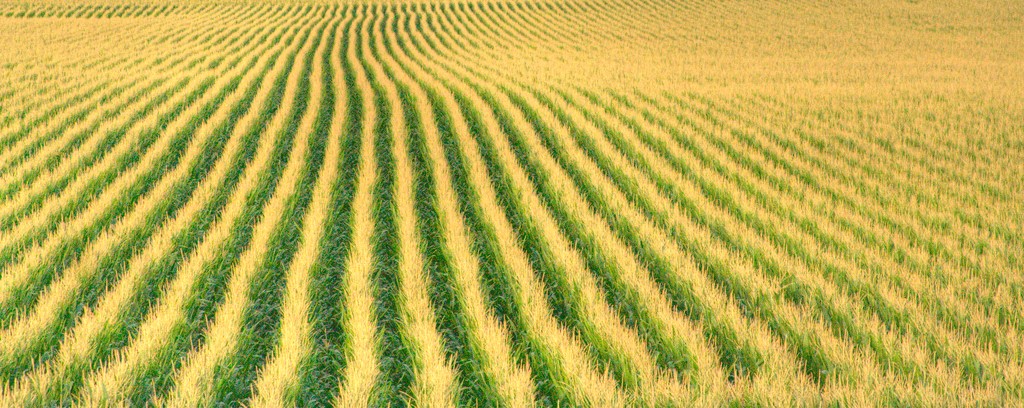
(Feature image credit: “Day 68 – Illinois Corn” Randy Wick/Flickr, CC)
In many ways, the focus of this blog is industrial agriculture—the problems it causes, the food and labor systems that are built around it, and its alternatives. I’ll do more detailed posts on many of the things in this one, but for now, here’s a summary of some of the issues with industrial agriculture.
This one’s long but super important! If you don’t have time to read all of it, there’s a summary of this summary (tl;dr) at the end of the post and hopefully the section headings can help you skim.
WHAT IS INDUSTRIAL AGRICULTURE, ANYWAY?
It’s the way we do most of our agriculture in the US and increasingly, around the world. It’s likely what’s happening on the farms from which you buy your food (unless you produce your own food, frequent farmer’s markets or some coops, or have a CSA subscription).
Industrial agriculture is a term used to refer to intensive agricultural systems that rely on mechanization, heavy use of inputs (pesticides, fertilizers, etc.), and large large-scale farming. Industrial agricultural systems are almost always characterized by annual crops (which live their full lives in a year; in contrast perennials grow year after year and can be harvested many times) and very little crop diversity. They are focused almost entirely on achieving one objective—high yield.
WHERE IS IT HAPPENING?
Everywhere. Between the 1940s and 1960s intensive agricultural practices—previously adopted primarily in the US—went global. This globalization is referred to (rather dramatically) as the Green Revolution, and it included both the expansion and transfer of agricultural innovations (particularly the heavy use of irrigation, fertilizers, and pesticides) and widespread adoption of high yielding cultivars. Gradually, the expansion of other aspects of industrial agriculture—including large farm size, greater mechanization, and increasingly, genetically modified crops—has followed.
THE PROBLEMS
There is no doubt that industrial agriculture is efficient, but this efficiency comes at a serious environmental and social cost. Here are some of the issues:
Soil Erosion
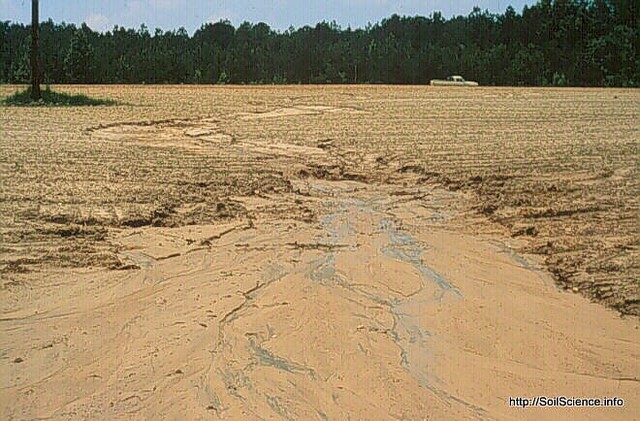
Why is soil important? Topsoil is necessary for agriculture. It’s where plants get most of their nutrients and where their roots are concentrated.
What’s causing erosion? The expansion of annual crops, increases in farm size, and intensive tillage. Annual crops have shallower root systems than do perennials meaning they do a worse job of holding the soil in place, and unlike perennials, annuals don’t not cover the soil year-round. Increases in farm size have accelerated the removal of hedgerows and vegetation strips that help keep soil from blowing around. Heavy tilling of the soil leaves it loosened and exposed. Exposed soil erodes quickly.
The result: at the rate it’s disappearing, we may have as few as 60 years of topsoil left. In the US, we’re currently losing topsoil at a rate of 12,000 pounds per person per year. This may not seem like a big deal…until you consider it can take up to 1,000 years to form an inch of topsoil1. Because topsoil is needed for farming, its loss has resulted in the abandonment of 12,000,000 ha of land per year2. (For some good (and alarming) info on this see this research and the summary of it here).
Lots of inputs
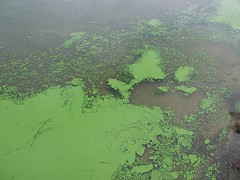
- Fertilizer. Fertilizer use has increased ten-fold between 1950 and 19903. Why is this a problem? You may have seen pictures of dead zones, algal blooms (red tides). If you’ve wondered what causes them, fertilizers are the culprit. The problem with fertilizer (both organic and synthetic) is that whatever plants don’t use can run off into water sources. When this happens, it causes eutrophication. Eutrophication works like this: 1. Excess nitrates from fertilizer runoff promote the growth of algae. 2. The algae, loving all the nutrients, grows like crazy and uses up all the available oxygen (red tides are caused by a proliferation of certain species of red algae) 3. Aquatic organisms die. Clearly not a good situation if you are a fish or a fisherman.
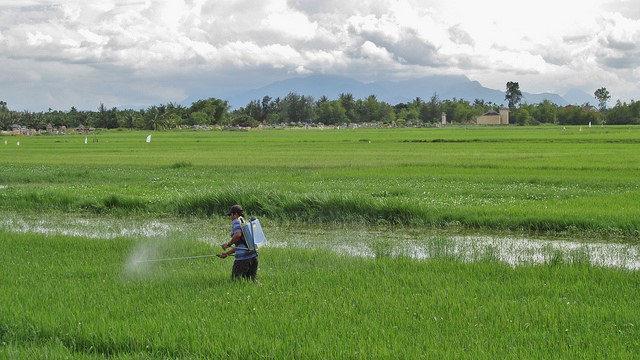
Pesticides. Pesticides technically include both insecticides (used to kill insects) and herbicides (used to kill plants). The result:
- Pesticide resistance. Overuse of pesticides promotes pesticide resistance (similar to antibiotic resistance) where
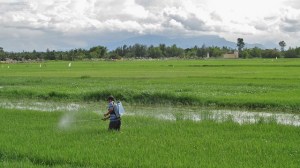
“spraying pesticide on rice” (cropped), garycycles/flickr, CC insect pests and weeds evolve defenses against pesticides rendering those pesticides ineffective. Out of 66 countries around the world, the US has almost 3 times the number of herbicide resistant weeds (151) of any other country. (Here is a fun interactive map of the number and species by state.) Globally over 550 identified insect pests are known to be somewhat resistant to insecticides and several severe pests are resistant to all insecticides4. Despite increases in the amount and toxicity of pesticides applied, there has been nearly a two-fold increase in crop losses to pests since 19405.
- Harm to non-target organisms (including soil organisms, birds, aquatic life, amphibians, insect predators that prey on pests, and pollinators). The story you may hear in the news is that the most widely used class of pesticides, neonicotinoids, may be indirectly contributing to (though are not likely the only cause of) Colony Collapse Disorder (CCD), a phenomenon that has caused rapid declines in honeybee populations6.Pesticides may be doing even more damage to wild pollinators who, though frequently disregarded, are equally if not more important for crop pollination7.
- Direct human health effects. Certain pesticides have also been documented to promote itching, rashes, vomiting, headaches, swelling, dizziness, intestinal parasites, dermatitis, and respiratory conditions, particularly in those who apply them8. In fact, according to a World Health Organization estimate, globally, 6 or more people are poisoned by pesticides each minute—220,000 die every year—and it is estimated that in the U.S. at least 300,000 farmworkers experience pesticide-related illnesses9. Because these risks disproportionally impact farmworkers who are predominately poor and Latin@, pesticide use also becomes a racial and class-based issue.
(See also, Energy Intensive.)
Energy intensive
With massive increases in inputs and the amount of mechanization, it is little surprise that industrial agriculture is incredibly energy intensive. But just how energy intensive is it? Here are some fast facts:
- As of 1977, agriculture was the largest user of petroleum of any industry and most of the energy used in production was used to produce pesticides and fertilizers.10
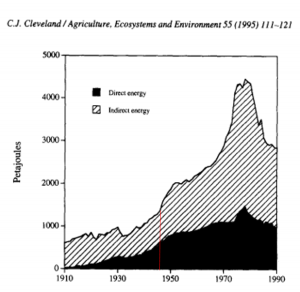
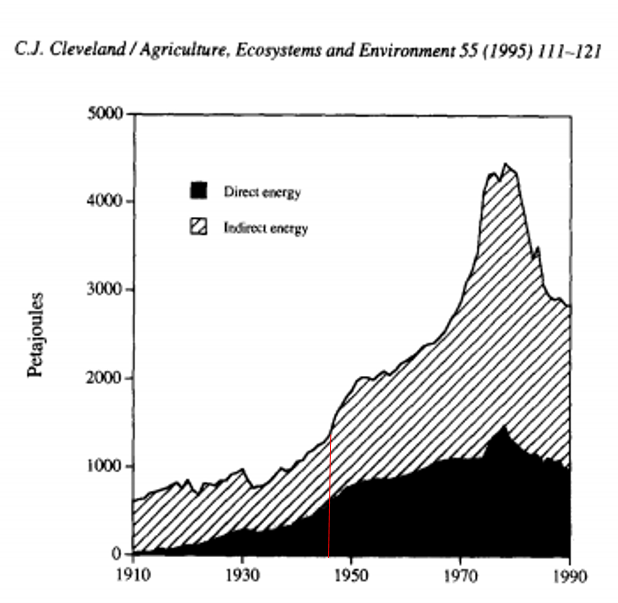
Clear increase in both indirect and direct energy use in agricultural production since 1910. Also, this is my own speculation, but notice the rapid increase around the end of WWII (1945)? I would be willing to bet that that spike reflects the increased use of pesticides—DDT, the first pesticide, was developed to control insects spreading typhus during WWII. - In the US, agricultural energy use in production (including both energy used on-farm and that used off farm to manufacture machinery and inputs) has increased more than 6-fold since 1910. Due to improvements in technology (prompted by high oil prices in the 70s), energy use has decreased slightly since the 70s, but it is still much, much higher than before the advent of industrial agriculture.11
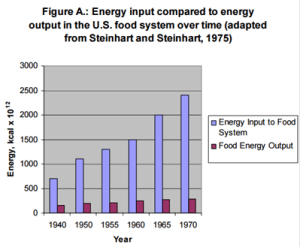
Energy input has increased much more than food energy output. - Energy productivity, the amount of food produced relative to the amount of energy input, has decreased over time meaning it now takes us more energy than in 1910 to produce the same amount of food.12
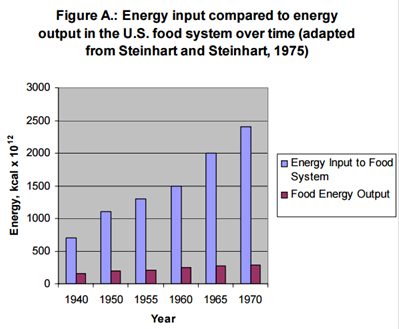
- The amount of energy used to process and distribute food is even greater than the energy used in production and this has also increased with industrial agriculture. The result? Including distribution, in 1991 it took 10-15 calories of energy to produce 1 calorie of food–that’s a lot of input relative to output!13
- Because fossil fuels are subject to large price fluctuations, the reliance of industrial agriculture on oil increases financial insecurity both for farmers and consumers. The global food price spike in 2007-2008, which caused political instability and exacerbated hunger, can be partially attributed to increases in oil prices14.
Mechanization
Soil compaction. In some ways, this one’s a no brainer—heavy equipment (which is really heavy now—tractor weight has increased from 4 tons in the 40s to 20 tons today) is going to compact the soil.
The result: Though under dry conditions moderate compaction can increase yields, compaction is usually bad because it makes it difficult for roots to penetrate the soil, and because there is less space between soil particles for water percolation, drainage, and gas exchange. This can lead to anaerobic soil and prevent nitrogen and phosphorous uptake. While surface compaction can often be broken up by tilling* and will naturally go away in 3-10 years, compaction below the surface—ironically often a result of tilling machinery which compacts the layer below the depth of the machine—is a serious and essentially permanent problem.
*Tilling refers to a variety of practices that break up the soil to prepare it for crop production.
(See also: Energy Intensive.)
Monoculture
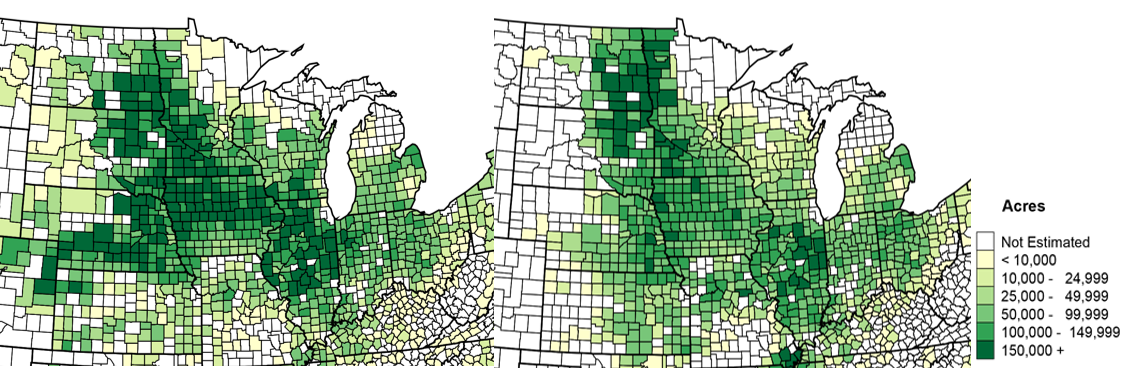
Monoculture refers to the cultivation of only a single type of crop (say, corn). Its antithesis, polyculture, is the planting of multiple crop species together. Specialization is the name of the game in industrial agriculture because its more efficient and makes it easier to use large machinery.
Note: While monoculture technically refers to growing a single crop in any size plot (true polyculture would involve planting multiple species together in even a small bed or row), smallish plots grown in monoculture within a patchwork of plots containing other types of crops or alternating types of row crops avoid many of the problems listed below.
The result:
- More inputs. Industrial agriculture relies on heavy inputs anyway, but monocultures may need more inputs than polyculture to achieve the same yields because they use nutrients less efficiently and promote less fertile soil. Why? In ecological systems plants take advantage of the available resources (e.g. nutrients, water) by having different heights, shapes, and root depths. Without diversity, fewer of the resources a given land area provides can be accessed and used15. Some plants also increase the amount of nutrients available for others. Plants in the pea family, for example, transform soil nitrogen into a form that’s usable by other plants. While less is known about soil life, some evidence16, shows that a diversity of species (as opposed to a monoculture) is able to provide a greater array of nutrients necessary to support a greater diversity of important soil microbes. A greater diversity of microbes in turn means more fertile soil and better cycling of nutrients.
- Fewer beneficial insects and more pests. Because all the plants in a monoculture are the same, they’re unable to provide high quality habitat, and thus do a worse job than more diverse systems of supporting beneficial organisms such as wild pollinators17 and seed dispersers. As many monocultures are annuals that have a short blooming season once a year, they can also produce a “feast or famine” situation in which pollinators either have a desert on which to dine or an overabundance of food18. Conversely, some evidence19 indicates that monocultures increase the abundance of specialized pests, possibly because they do not provide the natural defenses (e.g. certain repellant plants or habitat for pest predators) that can be promoted by diverse systems. (This also feeds into the need for more inputs—e.g. pesticides to manage pests, etc.)
- All eggs in one basket. Logically, monocultures don’t make sense. If all your plants are the same, you have no insurance. If a pest that is particularly fond of the one species you’re growing happens upon your field or you develop a disease specific to that plant, everything you have can be decimated.
-
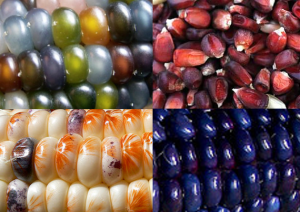
L-R, T-B: 1. Glass Gem Corn: “corn” (cropped), gnotalex/Flickr, CC 2. Bloody Butcher Corn: Copyright, Sustainable Seed Co. (cropped) 3. Anasazi Sweet Corn: “Colour” (cropped), donkeycart/Flickr, CC 4. Blue Maize: “BLUE MAIZE” (cropped), Bryant Olsen/Flickr, CC Loss of diversity/traditional varieties. The obsession of industrial agriculture with yield has meant a huge decrease in diversity. Where there used to be 100s, even 1,000s of varieties of each crop—the US, for example, once prided itself on 1000s of varieties of corn—there are now only a handful of varieties grown. In the process, more locally adapted, culturally significant, tastier, (and possibly more nutritious?) varieties (purposefully saved over generations for just those reasons) have been discarded or forgotten.
Large Farm Size/The Displacement of Small Farmers
America used to be a landscape of small family farms. No longer. The percentage of farmers in the US has decreased from 41% of the population in the early 1900s20 to less than 1% today21, and with the farmers has gone important site-specific knowledge of which farming practices are best for each region. Simultaneously, the US has seen massive consolidation of farmland into massive agribusinesses—since 1900 the number of farms has decreased by 63% and the average size has increased by 67%22.
Why? The expansion of large agribuisness has been due in a large part to changes in national agricultural policy spearheaded in the 1970s by Earl Butz, the secretary of agriculture under Nixon and Ford. Butz’ mantra was “get big or get out”, and he systematically set about undoing a series of New Deal policies aimed at preventing another dustbowl and sparing farmers and consumers from large price fluctuations (more about this to come!). These policies went into place at a time when there was a favorable export market, incentivizing farmers to scale up and to overproduce. When the market became saturated, prices crashed and many, many small farms went out of business. Those that survived expanded all the more in hopes of making ends meet. (For a more global outlook on all this, see Neocolonialism, land grabs.)
The result:
Lack of landscape heterogeneity. Going hand in hand with monocultures, increasing farm size means less diversity on a landscape scale as well as a field level. Like monocultures, this decrease in diversity has extremely negative consequences for our friends the bees23 as well as other beneficial organisms.
Loss of livelihood/knowledge. Many small farmers have been displaced by government policies promoting megafarms. The displacement of small farmers has resulted in a loss of site specific knowledge on which farming practices work best in specific areas.
Decreasing farmer sovereignty/increasing costs/increasing financial instability
Think industrial agriculture is helping farmers? Think again. Purchasing farming equipment, high-yielding or GM seeds, and all the inputs industrial agriculture requires is expensive. Many farmers are now forced to take out loans to purchase all they need, promoting indebtedness to moneylenders and landlords and decreasing farmer independence and profit. In the US, even with heavy agricultural subsidies, the amount of profit farmers make has dropped from 38% of the consumer dollar in 1940 to 17% today, and they must use more of this profit to repay loans24.
Global inequality
According to a meta-analysis of 117 studies on the economics of the Green Revolution25, 80% found that Green Revolution technology increased income inequalities within and between regions. Though this does not speak to whether or not industrial agriculture increased profits within countries, it is clear that at the very least it has benefited the wealthy countries disproportionately as it is wealthy nations that produce external inputs. The profit from these inputs stays in the national economy of the developed countries that produce them, but constitutes a loss to the (mostly developing) countries that must import them26.
Neocolonialism
The privileging of knowledge. Industrial agriculture is a Western export, and often, a tool to privilege Western knowledge, lifestyles, values (praised as more advanced and efficient) over those that are traditional and local. For example, at the advent of the Green Revolution, many farmers objected to growing high-yielding red rice over traditional white rice because they preferred the traditional taste27. Some countries such as Indonesia turned to heavy-handed government policies banning traditional varieties and enforced them by destroying crops of traditional species28. Closer to home, in Minnesota, there has been a movement away from traditionally grown varieties of wild rice to monocultures of industrial “wild” rice (“paddy rice”). This has not only changed the taste of the rice, but has also deprived Ojibwe communities of sustenance and the cultural customs associated with the harvest of the traditional varieties29. To make matters worse, growers of “paddy rice” are now marketing it as “wild” and using Objibwe images to sell it30.
Land grabs. In the developing world, “land grabs” by large foreign or national companies seeking to grow commercial export crops on an industrial scale have left many farmers landless and in need of alternative forms of employment31. Some argue that this trend also stimulates the national economy, eventually benefitting everyone32. Even if this is the case, however, it will likely exacerbate issues with hunger as more food is exported by foreign commercial producers from the countries that need it most and land critical for food security is eliminated.33
A SOLUTION TO HUNGER?
So there are clearly problems with industrial agriculture. But can it also be a solution? Does its merit as a potential solution outweigh its costs?
The grand achievement of industrial agriculture is high yields (though depending on how you measure yield this is also debatable—stay tuned for another post!) and high yields are seen as a solution to world hunger. Using traditional yield metrics, in many (though not all) areas, the yield increases brought by industrial agriculture are an undeniable success: between 1966 and 1997, available food-grain per capita increased by 18% globally with the most extreme increases in productivity in Asia where high-yielding rice varieties produced 70% more than traditional ones34.
But it turns out high yields have not solved the problem of world hunger. Some reports (including those from the FAO and CGIAR) indicate significant decreases in hunger due to Green Revolution technology. However, when China—where the most significant decreases occurred—is excluded from analyses, some reanalyses shows that food insecurity in the rest of the world actually increased by more than 11% despite the greater amount of food available per person35.
Either way, it is clear that there are still a large number of people who do not have sufficient food resources. As of 2009 for example, more than 1 billion people were considered food insecure36, and even in the U.S. 20.1% of children are at risk of hunger and 8.5% are hungry37. More and more research (e.g. Smith 1998, Uvin 1995, Lappé 1998, Pinstrup-Andersen 1994), is indicating that the problem with hunger is not a problem of yield; we don’t have to produce more food to feed the world (more on this to come as well). Instead, it appears the solution to hunger is increased access and distribution, a problem that may actually be exacerbated by our industrial agricultural system as globalization and land grabbing accelerates the stream of food leaving the countries where it’s needed most38.
Tl;dr
Industrial agriculture causes many social and environmental problems including those associated with:
- Soil erosion (the stats on this are really alarming!)
- Heavy reliance on inputs (irrigation, fertilizer, pesticides all of which have their own consequences)
- Heavy reliance on energy from oil (partially to produce all those inputs)
- Mechanization (in addition to being energy intensive, large machinery causes soil compaction which negatively impacts plant growth)
- Monocultures (leads to loss of ecosystem services/the need for more inputs)
- Huge farms/displacement of small farmers (bad for many beneficial organisms including bees/loss of livelihoods and site-specific knowledge about farming)
- Decreasing farmer sovereignty/increasing production costs (more reliance on companies for inputs, less self-reliance)
- Global inequality (profits stay in the hands of the developed countries that produce inputs)
- Neocolonialism (privileging of knowledge—industrial over traditional; large companies buy up land for expert crops where people need that land to survive)
While that seems like a formidable list, many still justify industrial agriculture on the basis of high yields, which are seen as a solution to world hunger. Trouble is, yield increases are not inversely proportional to decreases in hunger. Instead, problems with hunger are due primarily to poor access and distribution, issues which industrial agriculture only exacerbates.
References:
1. Fox, T. J. 2011. Urban Farming : Sustainable City Living in Your Backyard, in Your Community, and in the World. Irvine: Hobby Farm.
2. Pimentel, D., Harvey, C., Resosudarmo, P., Sinclair, K., Kurtz, D., McNair, M., Crist, S., Shpritz, L., Fitton, L., Saffouri, R., Blair, R. 1995. Environmental and economic costs of soil erosion and conservation benefits. Science. 267(5201):1117-1123.
3. Khush, G. S. 1999. Green Revolution: preparing for the 21st Century. Genome. 42(4):646-655.
4. Conway, G. 2012. One billion hungry: can we feed the world? Ithaca, NY: Cornel University Press.
5. Lappe, F. M., Collins, J., Rosset, P. 1998. World Hunger: 12 Myths (second ed., 2014). New York: Earthscan.
6. Are Neonicotinoids Killing Bees? Rep. The Xerces Society for Invertebrate Conservation, 2012. Web. 1 May 2015. <http://www.xerces.org/wp-content/uploads/2012/03/Are-Neonicotinoids-Killing-Bees_Xerces-Society1.pdf.
7. Kennedy, C. M. et al. 2013. A global quantitative synthesis of local and landscape effects on wild bee pollinators in agroecosystems. Ecology Letters. 16:584-599.
8. Lantz, P., Dupuis L., Reding, D., Krauska, M., Lappe, K. 1994. Peer Discussions of Cancer Among Hispanic Migrant Farm Workers. Public Health Reports 109(4): 512-20.
9. Lappe, F. M., Collins, J., Rosset, P. 1998. World Hunger: 12 Myths (second ed., 2014). New York: Earthscan.
10. Energy Use in the U.S. Food System: A Summary of Existing Research and Analysis. Rep. Center For Integrated Agricultural Systems, UW Madison, Jan. 1994. Web. 3 May 2015. <http://www.cias.wisc.edu/wp-content/uploads/2008/07/energyuse.pdf.
11. Cleveland, Cutler J. “The Direct and Indirect Use of Fossil Fuels in USA Agriculture, 1910-1990.” Agriculture, Ecosystems, and Environment 55 (1995): 111-21. Web. 3 May 2015. <http://www.researchgate.net/profile/Cutler_Cleveland/publication/223062675_The_direct_and_indirect_use_of_fossil_fuels_and_electricity_in_USA_agriculture_19101990/links/00b7d51b73e78774a9000000.pdf.
12. Energy Use in the U.S. Food System: A Summary of Existing Research and Analysis. Rep. Center For Integrated Agricultural Systems, UW Madison, Jan. 1994. Web. 3 May 2015. <http://www.cias.wisc.edu/wp-content/uploads/2008/07/energyuse.pdf.
13. Energy Use in the U.S. Food System: A Summary of Existing Research and Analysis. Rep. Center For Integrated Agricultural Systems, UW Madison, Jan. 1994. Web. 3 May 2015. <http://www.cias.wisc.edu/wp-content/uploads/2008/07/energyuse.pdf>.
14. Conway, G. 2012. One billion hungry: can we feed the world? Ithaca, NY: Cornel University Press.
15. Hooper, D. U. and Dukes, J. S. 2004. Overyeilding among plant functional groups in a long term experiment. Ecology Letters. 7:95-105.; Bracken, M. E. S. 2008. Monocultures versus polycultures. In Jørgensen, S. E. and Fath, B. D., editors. Encyclopedia of Ecology: General Ecology (3). Oxford: Elsevier. 2446-2449.
16. Zak, D. R., Holmes, W. E., White, D. C., Peacock, A. D., Tilman, D. 2003. Plant diversity, soil microbial communities, and ecosystem function: are there any links? Ecology. 84(8):2042-2050.
17. Kennedy, C. M. et al. 2013. A global quantitative synthesis of local and landscape effects on wild bee pollinators in agroecosystems. Ecology Letters. 16:584-599.; Kremen, C. and Miles, A. 2012. Ecosystem services in biologically diversified versus conventional farming systems: benefits, externalities, and trade-offs. Ecology and Society. 17(4):40.
18. Kremen, C. 2012. Edible Education 103: A Bee’s Eye View by Claire Kremen. The Edible Schoolyard Project: UC Berkeley’s Edible Education Lecture Series. https://edibleschoolyard.org/node/5434.
19. e.g. Andow, D. A. 1991. Vegetational diversity and arthropod population response. Annual Review of Entomology. 36:561-586.
20. Dimitri, C., Effland, A., Conklin, N., 2005. The 20th Century Transformation of U.S. Agriculture and Farm Policy. USDA Economic Research Service, Economic Information Bulletin 3. http://ageconsearch.umn.edu/bitstream/59390/2/eib3.pdf (May 9, 2013).
21. [US EPA] The United States Environmental Protection Agency: Agriculture Division. Ag 101: Demographics. 2013 April 15. http://www.epa.gov/oecaagct/ag101/demographics.html [Accessed: 2014 March 29].
22. Dimitri, C., Effland, A., Conklin, N., 2005. The 20th Century Transformation of U.S. Agriculture and Farm Policy. USDA Economic Research Service, Economic Information Bulletin 3. http://ageconsearch.umn.edu/bitstream/59390/2/eib3.pdf (May 9, 2013).
23. Kennedy, C. M. et al. 2013. A global quantitative synthesis of local and landscape effects on wild bee pollinators in agroecosystems. Ecology Letters. 16:584-599.; Kremen, C. and Miles, A. 2012. Ecosystem services in biologically diversified versus conventional farming systems: benefits, externalities, and trade-offs. Ecology and Society. 17(4):40.
24. Lappe, F. M., Collins, J., Rosset, P. 1998. World Hunger: 12 Myths (second ed., 2014). New York: Earthscan.
25. Freedbairn, D. K. 1995. Did the Green Revolution Concentrate Incomes? A Quantitative Study of Research Reports. World Development. 23(2):265-279.
26. Lappe, F. M., Collins, J., Rosset, P. 1998. World Hunger: 12 Myths (second ed., 2014). New York: Earthscan.
27. Conway, G. 1997. The doubly green revolution: food for all in the 21st century. Ithaca, NY: Cornel University Press.
28. Ibid.
29. LaDuke, W. 2005. Recovering the sacred: the power of naming and claiming. Cambridge: South End Press.
30. Ibid.
31. Conway, G. 2012. One billion hungry: can we feed the world? Ithaca, NY: Cornel University Press.
32. Ibid.
33. Ibid.
34. Khush, G. S. 1999. Green Revolution: preparing for the 21st Century. Genome. 42(4):646-655.
35. Lappe, F. M., Collins, J., Rosset, P. 1998. World Hunger: 12 Myths (second ed., 2014). New York: Earthscan.
36. Brussaard, L., Caron, P., Campbell, B., Liper, L., Mainka, S., Rabbinge, R., Babin, D., Pulleman, M. 2010. Reconciling biodiversity conservation and food security: scientific challenges for a new agriculture. Current Opinion in Environmental Sustainability. 2:34-42.; Conway, G. 2012. One billion hungry: can we feed the world? Ithaca, NY: Cornel University Press.
37. Lappe, F. M., Collins, J., Rosset, P. 1998. World Hunger: 12 Myths (second ed., 2014). New York: Earthscan.
38. Conway, G. 2012. One billion hungry: can we feed the world? Ithaca, NY: Cornel University Press.; Lappe, F. M., Collins, J., Rosset, P. 1998. World Hunger: 12 Myths (second ed., 2014). New York: Earthscan.
 erin-lowe.com
Leave a comment